Rachel Tolentino- college_girl8509@tamu.edu
email Rachel if you want to study with her group (being assembled) and you can work out a time
also email me if you want to be a facilitator and have your email put up here for others to contact you
Wednesday, February 25, 2009

Friday, February 13, 2009
QuiXam 2 Next Friday, 2/20
You will need to know
1) everything we studied for QuiXam 1.
2) human biological adaptations for speech/language
3) vocal tract anatomy
4) everything about orthography including
problems with phonics, orthographies, deep and shallow orthographies
5) places and manner of articulation for English consonants
MEMORIZE the CONSONANT CHART!!
I will give you scrap paper, so the first thing you'll do when you start the test is write it out from memory. This will enable you to answer all sorts of questions about consonants and their feature bundles-voicedness, place of articulation, and manner of articulation
Thursday, February 5, 2009
A small extra credit op
for me to know who i'm e-mailing in the moment and learn your names faster- i'll add one point to your quiXam if you start including your digital pic with your email (as an attachment). i'll do it again for the next exam if you continue the practice. 
Wednesday, February 4, 2009
Friday's Exam
There's a nice list of study questions on p. 26 in the second installment of chaplets, Adaptations & Orthography.
Here is a pithier set:
Know the difference between prescriptive and descriptive and that your grandmother has perfect grammar.
What passed for linguistics before modern linguistics? What/who was privileged? What was the goal of that approach to language study? What was ironic about New Testament Greek?
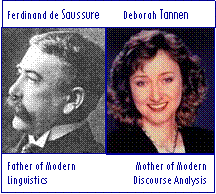
Saussure, descriptive/prescriptive, semiotics, synchronic/diachronic, syntagmatic/paradigmatic, langue and parole
Genie-critical window of first language acquisition
Science and Ideology
Chomsky: the LAD, the UG, competence vs performance, relationship between human language and other primates we know of
form and function, formal linguistics vs functional linguistics
animal communication systems,what they can't do that humans can
design features-we actually went over most of these in class when we talked about animal communication systems, so we'll go ahead and cover them
I'm going to add to this so check back in.
Friday, October 24, 2008
Excellent IPA Tutorial, etc , compliments of Chris Duffel
instead of having to know the combination code for each character ...
and also this one
its an interactive run through of ipa characters
The second one actually tests you over words, English to IPA and IPA to English; very cool and approved by ee! (:
The second one actually tests you over words, English to IPA and IPA to English; very cool and approved by ee! (:
All the IPA symbols in one sentence, modified to include previously missing symbols

Tuesday, October 21, 2008
Minimal Pairs
 A minimal pair proves that two phones (i.e., sounds) are completely separate phonemes in that language (and not two different variations of the same sound like our various pronunciations for /t/).
A minimal pair consists of two words in a given language with all the same sounds (in the same sequence) except for one, in the same place in the word.
For example, cap and gap are minimal pairs showing that /k/ and /g/ are separate phonemes in English. You can also have minimal triplets or minimal sets of sounds that are quite long. so add tap map, nap rap lap, sap, zap,map, chap, yap, (but not dap, wap, shap, zhap, bap, fap, vap, which are all lexical gaps just waiting to have a meaning assigned to them),
But not crap. Why not? It has more than 3 segments/phones in it, which is all the others in the set have.
On the other hand, crap and clap are a minimal pair, showing that /l/ and /r/ are separate phonemes in English (or allophones of separate phonemes, to be more accurate).
However, crap and crop are minimal pairs showing that /ae/ and /a/ are separate phonemes.
And crop and crock are minimal pairs showing that /p/ and /k/ are separate phonemes (in case you thought they were two variations of the same sound (: , which would just be sad ).
So the contrastive sound in a minimal pair can be initial, medial, or final in position, as long as both are in the same position in their respective words.
Subscribe to:
Posts (Atom)