Friday, October 24, 2008

Excellent IPA Tutorial, etc , compliments of Chris Duffel

instead of having to know the combination code for each character ...
and also this one
its an interactive run through of ipa characters


The second one actually tests you over words, English to IPA and IPA to English; very cool and approved by ee! (:

All the IPA symbols in one sentence, modified to include previously missing symbols


instead of having to know the combination code for each character ...

it's an interactive run through of ipa characters


The second one actually tests you over words, English to IPA and IPA to English; very cool and approved by ee (:

Tuesday, October 21, 2008

Minimal Pairs

A minimal pair proves that two phones (i.e., sounds) are completely separate phonemes in that language (and not two different variations of the same sound like our various pronunciations for /t/).

A minimal pair consists of two words in a given language with all the same sounds (in the same sequence) except for one, in the same place in the word.


For example,
cap and gap are minimal pairs showing that /k/ and /g/ are separate phonemes in English. You can also have minimal triplets or minimal sets of sounds that are quite long. so add tap map, nap rap lap, sap, zap,map, chap, yap, (but not dap, wap, shap, zhap, bap, fap, vap, which are all lexical gaps just waiting to have a meaning assigned to them),

But not crap. Why not? It has more than 3 segments/phones in it, which is all the others in the set have.

On the other hand, crap and clap are a minimal pair, showing that /l/ and /r/ are separate phonemes in English (or allophones of separate phonemes, to be more accurate).

However, crap and crop are minimal pairs showing that /ae/ and /a/ are separate phonemes.

And crop and crock are minimal pairs showing that /p/ and /k/ are separate phonemes (in case you thought they were two variations of the same sound (: , which would just be sad ).

So the contrastive sound in a minimal pair can be initial, medial, or final in position, as long as both are in the same position in their respective words.

Stuff you can do with linguistics

Some Applications of Linguistics

Speech pathology: children, stroke victims, persons with other kinds of brain damage or language complication.

Accent reduction: Teach people to talk like everybody else ; this is particularly helpful if you want to be a spy. Sometimes people with strong dialects are turned down for employment, esp. if communication with the public, etc. is a big part of the job (answering phones, for example)

Writing fiction, etc: Represent dialects or language varieties accurately; use knowledge of language to bring about certain effects on the reader. Poe was very linguistically purposeful in the way he went about writing The Raven, Lanore. (:

Vocal performance: Be able to produce the sounds of songs in foreign languages you don’t actually know. Singing operas in Italian and so forth, which most of you do weekly, I'm sure

Actor: Be able to adopt the language variety of the character you are portraying. I.E. be Meryl Streep.

Government/politics: Be a diplomat (or a spy) (or both)

Military intelligence: Code breaking/Code making; communicating with the ‘enemy,’ combatants or otherwise. . .

Foreign language teaching: ESL or any other language. Speech and/or writing systems.

Other teaching: Teaching content areas to students in a language that is not native to them (e.g., teaching history in English to native speakers of Farsi).

Translation or Interpretation (written ((diachronic or synchronic)) or real time spoken) for the FBI, CIA , Corporate world or a zillion other spheres.

Computational linguistics: Teach computers to think like and communicate better with humans.
Create Machine translators for the FBI, CIA or Corporate world.

Cognitive linguistics: Use language to understand the cognition of the human brain.

Neurolinguistics: Identify parts of the brain that control various linguistic functions. . .

Psycholinguistics: Understand first and/or second language acquisition and bilingualism (different)
Understand something about human behavior and language

Experimental psychology: use language as a key to human psychology and processing.

Communications:
Marketing, Interfacing optimally with the public, understanding nonverbal communication; managing media production (including handing off the speaker turn to somebody at a remote location)

Teaching Reading to Children (or Adults): Be able to understand how dialect differences affect a person’s ability to connect orthography with the sounds of a language; understand the psychological processing of language for reading. . . .

Editing, Teaching Grammatical Styles: Syntax helps you understand and convey the ‘rules’ of a language, both prescriptive and descriptive.

Law: Be an expert witness as to where a person is most likely from, whether they are a native of x language, whether differences in their stories are likely to be due to fabrication or the normal processes of the human brain’s production of narrative from memory. . .

Medicine: Know whether the language anomalies in a patient’s speech are pathological and/or what pathology they are evidence of.

Language Planning & Policy: Help form public policy that regulates the use of language in a country or society (for various purposes). People who think “English Only” in the U.S. is a good idea are one example, people who want to argue for diversity of language and get legislation to protect this are another.

Choose or develop an orthography for your (nation’s) language. (E.g., Ataturk changed the Turkish writing system from Arabic script to the Roman script I am writing in right now).

Philosophy: Combine linguistics with logic and math to chase English and Anthropology majors away.

Academics: Teach, write scintillating articles, overwhelm people with your incomprehensibility to make them think you’re a genius, make not very much money.

Cultural Anthropology: Get into the ‘minds’ of your informants; discover unique linguistically encoded cultural features, assumptions in words and structures that do not exist in other languages.

Archeological Anthropology: Translate ancient texts; reconstruct ancient languages, etc.

Evolutionary/Biological Anthropology: Study animal communication systems and try to reconstruct the path of the evolution of language.

Sunday, September 7, 2008

Speaking of Parrots Speaking. . .

Here's an entertaining clip of an African gray doing some 'impersonations'

http://news.bbc.co.uk/2/hi/uk_news/7600955.stm

Monday, September 1, 2008

some ipa to whet your appetite

ju prabəbli wʊdnt wɝi əbaʊt wat pipəl Θɪnk Λv ju ɪf ju kʊd no haʊ sɛldəm ðe du.

ɔlən mɪlɚ.


Friday, August 29, 2008

Reviewing 8-28-08

What existed before Linguistics? Why was language studied? What was its purpose? What varieties of language were seen as valid objects of academic pursuit? What variety of what language was an exception to the 'prestige' condition? Why? What's ironic about that in the way that original work was translated into languages all over the world for the next 20 centuries or so after it was written?

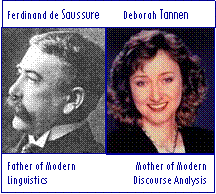
Who is called the father of modern linguistics? What country was he from? How did he come to teach this course? What did he propound were the neglected elements of language that a scientific approach would have to attend to? What is metalanguage? What terms did Saussure introduce? What is the relationship of anthropology to linguistics? (This could be a trick question).

What do these terms mean?
metalanguage
semiotics

prescriptive vs. descriptive
diachronic vs. synchronic
langue vs. parole
paradigmatic vs. syntagmatic, which is illustrated by and which is illustrated by ?

What is schema and how does it relate to semiotics?
Why do you have to teach a computer about the qualities of a room before it can 'understand' a story that involves a room?

What do linguistic, paralinguistic and extralinguistic mean?

How do linguists define GRAMMAR?? Why does ee insist that your grandma has perfect grammar in her native language?

What is the difference between 'good' English and 'standard' English, 'bad' English and 'nonstandard' English? Which should cause you to break out in hives?

How is semiotics related to intellectual curiosity as presented in class?

How did the French accidentally invent dialectology?
Why is American Sign Language more like spoken French than spoken English?

Why is narrative so important in the classroom according to mee?

How is the way you talk related to your identity?

Who is Wallace Chafe? What fruit is featured in the title of the important book comparing oral and written language within and between cultures? The ____ Stories. What animal will become the central artifact in the American Southern imagination in the 21st century? Wait, that wasn't my question. . . whose was it?

What is the irony of how the study of language progressed from written to spoken to gesture?

Bonus info: how not to make yourself America bait overseas, how to deflect the identity of an ugly monolingual American in Europe. . . how not to get chased by a band of angry protestors in Brussels, the truth about ugly babies, the virtues of naming your children after your siblings, the origin of madelina margarita, the significance of Sanskrit in East Asian languages, whether or not Chinese and Korean are related. . . who are Roger Shuy, Ralph Fasold and Walt Wolfram? What is the word for a line on a map that shows generally where one dialect ends and another begins regionally? What does learning two languages simultaneously as a baby do to your brain?